Your first agency assignment can come with several documents that mention pay. They do different jobs. The key information document explains the proposed payment arrangement; your terms set out the agreement; assignment details describe a particular job; and a payslip records an actual payment.
Reading them together helps you ask a more useful question than “What is the hourly rate?” You need to know which rate is being quoted, who pays you and what will come out before the money reaches your account.

What is a key information document?
A key information document, often shortened to KID, is a brief explanation of how an agency worker will be paid. GOV.UK’s agency-worker guidance (opens in a new tab) says it should cover the expected minimum pay, the payer, relevant fees or benefits and an example of take-home pay.
The requirement applies to new arrangements from 6 April 2020; GOV.UK notes an exception where terms were already agreed before that date. It is information to read before committing, not a guarantee that every future assignment or pay period will produce the example amount.
- KIDThe proposed pay arrangement.
- AssignmentThe particular job, hours and rate.
- PayslipWhat was paid for that period.
Keep the documents in their proper roles
- KID: understand the proposed pay arrangement and its example figures.
- Terms of engagement: read the agreement, including pay, notice and holiday provisions.
- Assignment details: check the particular work, hours, location and agreed rate.
- Payslip: review what was paid for the actual pay period.
Save these together, with the date each version was received. If a number looks different, identify the document and the pay period before comparing it. A weekly illustration and a monthly payment are not directly comparable.
A fictional example: what would you ask?
Fictional example: the names and figures below illustrate how to read pay information. They are not a complete KID or a tax calculation.
| Example field | What to check |
|---|---|
| Responsible for paying you: Example Payroll Ltd | Is this the organisation named in your agreement, and who answers payroll questions? |
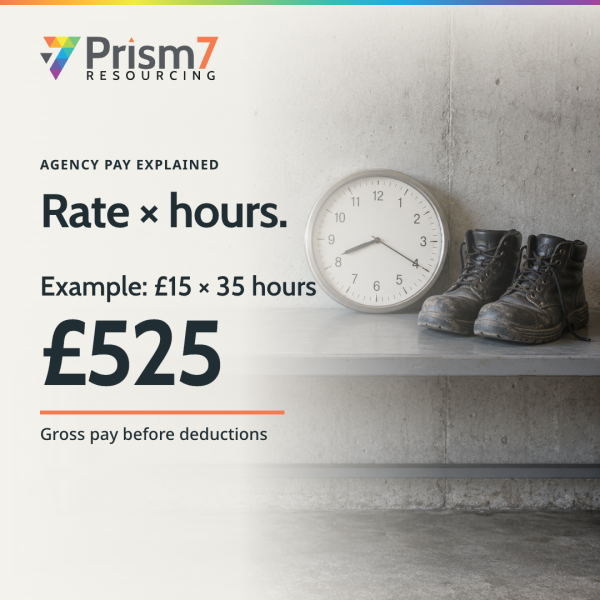
| Gross hourly pay to the worker: £15 | Is this your gross pay, rather than a rate paid to another company? |
| Illustrative hours: 35 | Does the example use paid hours? Check how breaks and variable hours are treated in your assignment. |
| Illustrative gross pay: £525 | £15 multiplied by 35 explains the example gross figure. It does not establish take-home pay. |
| Deductions and estimated net pay | Ask for the actual document’s itemised deductions and estimated take-home pay. |
Suppose your eventual assignment has 30 paid hours at the same gross rate. The gross amount from those hours would be £450, before any other applicable payments or deductions. That arithmetic explains a possible difference in hours; it does not settle whether your payslip is correct. Compare the agreed hours with the hours recorded and paid.
If an umbrella company is involved
An umbrella arrangement adds another distinction. The amount the agency pays the umbrella company is not necessarily the worker’s gross pay. Business employment costs and the umbrella’s margin may be accounted for before gross worker pay is calculated; deductions from the worker’s pay are a separate stage.
The government’s umbrella-company KID guide (opens in a new tab), which applies to England, Scotland and Wales, explains the fields and the representative pay statement. Ask which figure a quoted “assignment rate” refers to before comparing it with another offer.
This section applies only where an umbrella company is involved. It does not describe how every agency or Prism 7 pays every worker.
Questions worth settling before you start
Write down anything that remains unclear: who pays you, the pay frequency, how to submit hours, who approves them, how holiday pay is handled and where deductions are explained. Ask for an answer against your own paperwork rather than relying on someone else’s payslip or an online take-home estimate.
If the payer or another significant part of the arrangement changes, request the updated information. The official umbrella guidance sets out when a revised KID should be supplied and the current route for raising concerns.
For your own records, note the question, the person who answered it and the document that confirms the answer. Never share National Insurance numbers, bank details or a complete payslip in public comments to seek help.
Choose work with clear terms
Read our candidate advice and explore current opportunities. Before accepting an assignment, ask the recruiting team to explain any part of its pay information you do not understand.